


Your complimentary articles
You’ve read one of your two complimentary articles for this month. To have complete access to the thousands of philosophy articles on this site, please
You can register for a free account to have four complimentary articles per month. We will occasionally email you a newsletter, from which you can unsubscribe at any time. We do not sell personal data or otherwise disclose personal information to other organisations.
Television
Star Trek: Enterprise
Sofia Villaweaver asks, what kind of future do we want – Gene Roddenberry’s, or Friedrich Nietzsche’s?
At first glance, the German philosopher Friedrich Nietzsche (1844-1900) and the long-running US TV franchise Star Trek seem unlikely combatants. But they have visions of future humanity that are fundamentally opposed. So as both a sci-fi nerd and a lover of philosophy, my ears pricked up when Nietzsche was parroted in an episode of Star Trek: Enterprise by an Augment, a genetically modified human with superior intellect and strength and zero pesky moral inhibitions. The Augment, named Malik, loftily proclaims to the Enterprise’s morally upstanding Captain Archer: “We [Augments] don’t care what happens to you. Humanity is no longer relevant. To quote one of your philosophers, Nietzsche: ‘mankind is something to be surpassed’.” Malik uses this as a justification to seize power over what he sees as an inferior version of humanity. In essence, he believes himself to be an Übermensch or ‘superman’ of Nietzsche’s far-flung dreams – a being who transcends normal human herd morality, overcomes everything comfortable within himself and celebrates life it in all its bloody but beautiful truth.
Someone might argue that Malik has taken the great philosopher’s teachings and twisted them to suit his own will; yet I cannot think of anything more Nietzschean than doing just that. In The Genealogy of Morals (1887), Nietzsche argues that our original concepts of good and evil developed from the division between the aristocratic and the plebeian classes, with the aristocrats associating their masterly actions and values with what is noble and praiseworthy, and as an afterthought, contrasting the humbleness and vulgarity of the peasants with the opposite. He says the lower classes then fought against their repression by promoting a Christian moral system that he calls ‘slave morality’, which protects the weak and defenceless (that is, themselves) by vilifying the power-exertions of those in power. The success of this mission gave rise to modern ideals of equality, forgiveness, and compassion – virtues that, according to Nietzsche, are a denial of the true nature of life, whose true expression is the will to power.
In simple terms, the will to power is essentially the desire to assert oneself, overcome obstacles and contrary opinions, and achieve complete freedom to recreate life on one’s own terms, often joyously. In the more brutal interpretations of Nietzsche’s idea, this self-assertion can be unapologetically at the expense of others. For Nietzsche, the ‘slave’ drive to eradicate their own suffering and de-claw the birds of prey that terrorise the sheep heralds the decline of humanity’s essential strength, which is borne from opposition, conflict, and warfare.
Many right wing and fascist ideologies express fear of racial or ideological purity being watered down or polluted by lesser beings contaminated by weakness. It’s no wonder then, that Nietzsche’s writings were often co-opted by the anti-Semites of the twentieth century, particularly the Nazis, who scapegoated the Jews as a corrupting force, with devastating consequences. It’s important to note though that Nietzsche defended the Jews in several passages throughout his works, and that his sister Elisabeth is to be blamed for warping his writings to suit Nazi ideology, which he would have hated. (Indeed, in doing so, she became a personal friend of Adolf Hitler.)
Malik the Augment, however, is unquestionably a Nietzschean bird of prey – someone who denies the relevance of the suffering of the sheep beneath his claws. His enhanced abilities mean his lot is freedom to act and the ultimate expression of power and life. And like Nietzsche, he may argue that suffering isn’t bad in itself, but a way for man to sharpen his wits, against the cold rockface of hardship. After all, it was Nietzsche who first said “Whatever doesn’t kill me makes me stronger.”
This begs the question: if Malik or similarly genetically-modified people could be Nietzschean superhumans, would anyone really want a whole society composed of such people – basically, ultra-strong sociopaths with high IQs? (Trekkies might also include the infamous Q in their list of powerful sociopaths. Q is an extra-dimensional entity who can control time, space, and matter, and who playfully toys with humans and their dull, unimaginative morals – especially Jean-Luc Picard.)
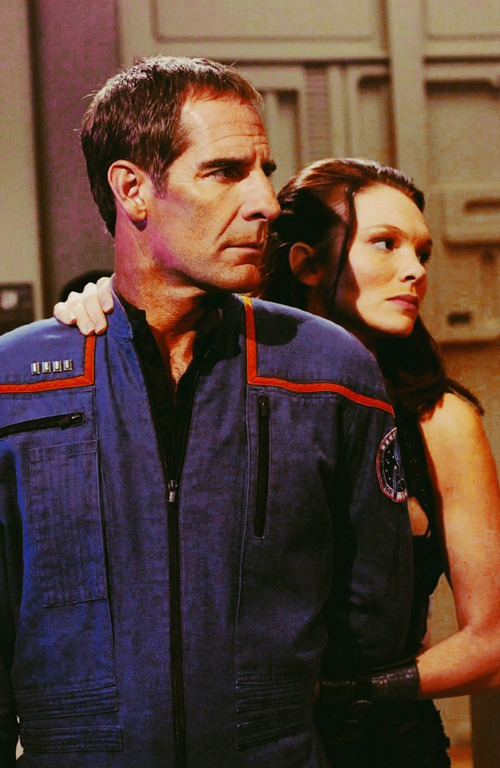
Captain Archer is captured by an Augment
Enterprise Images © Paramount Network Television 2001
Towards The Final Frontier
Behold! There is an alternative, argues the creator of Star Trek, Gene Roddenberry (1921-1991). In the Trek universe he built he presents a perhaps overly optimistic vision of the future, where humanity embodies a democratic and socialist vision of peaceful coexistence that transcends race, religion, gender, and even the need for money. In this society, humans recognise error of their ways after a nuclear war that almost ends our existence. Awakening to a new dawn, we overcome our petty differences, celebrate our individual strengths, and promote the flourishing of the collective. Imagine Aristotle’s eudaimonia – a life that gains happiness by fulfilling its potential – and John Stuart Mill’s ‘greatest happiness for the greatest number’ principles having a baby, and you have the Trekkie utopia.
One can imagine Nietzsche squirming, if not rolling, in his grave: without war, conquest, and life’s drive for dominance, what a homogenised, seething mass of weakness would humanity become! A bland, grey version of a once bold and beautiful painting; drab, safe, and the antithesis of natural selection and true life.
Star Trek’s warrior races, such as the Klingons or Cardassians, would probably agree. And yet the Federation characters beloved by Star Trek fans are the opposite of lame, cowardly sheep. For instance, in the original series, Captain Kirk and his crew frequently discover worlds that have become Nietzschean nightmares of docility and fiercely oppose these stagnant societies. One might say it’s a bit of a theme, suggesting Star Trek and Nietzsche aren’t fundamentally opposed. However, it’s true that the captains and officers are distinctly moral and often face situations that lead to deep philosophical enquiry – Captain Picard’s ethical monologues and debates are famous among fans. They are compassionate; but they make tough calls and compromise when necessary. They intend peace, but don’t shy away from the fight if it’s necessary to protect themselves and the innocent. Most starship officers are mentally sharp, highly creative, adaptive, skilled, and brave. Strength in the broader sense is respected, but every member of the crew is empowered to stand up to their superiors if, like Roman emperors of old, they forget they are all too human, all too mortal, and make foolish or immoral decisions. Crucially, no one is excluded from mastering themselves and their destiny. There is indeed plenty of personal and societal development across the franchise.
This is an important point to me personally. Nietzsche’s view of man’s future is extremely narrow, and very masculine: as he argues in Beyond Good and Evil (1886), women are better off staying silent and small, dreaming only of giving birth to a beloved superman. But if the will to power is synonymous with life, then, dear Nietzsche – privileged white man that you were – as a living, breathing, conscious being, I claim the will to power as my right as a woman, too.
An Alternative Alternative
I admit Star Trek is perhaps too optimistic in its vision of humanity’s future to be compatible with true human nature. And with the great minds of the twenty-first century already playing with trifles such as genetic engineering, AI, nuclear weapons, and settling Mars, who’s to say which we’ll invent first – Augments, or a United Federation? Interestingly, many proponents of the ‘Frontier Thesis’ of space exploration believe that settling on other planets will invigorate the human spirit in the same way that frontier culture apparently drove America to independence and world dominance. Think ‘Make America Great Again’ but for our interstellar descendants: ‘Make Humanity Great Again’! However, it may take an unrealisable Herculean collective effort to overcome our tribal instincts in order to colonise (let alone terraform) other planets. The will to power may bring about the very kind of disaster that gave rise to warp drive in the series – a world war. But if this or other human conflict launches us into space, this might ironically ensure the survival of our species, in a Star Trek-like fashion. Alternatively, it might prevent us from ever leaving this beautiful blue marble and exploring the universe.
Star Trek: Enterprise toys with the Frontier Thesis in its two-parter ‘Into the Mirror, Darkly’, which is set in an alternative universe. When the Vulcans visit Earth to introduce themselves after detecting Zefram Cochrane’s first warp flight, humans in this alternative timeline decide not to make allies with the Vulcans (as they do in the standard Trek universe), but to murder them and pirate their ship. A ruthless, bloody conflict ensues, with humans, rather than forming a peaceful Federation, subjugating multiple planets by force. In many ways, the resulting Terran Empire is a pure manifestation of Nietzsche’s will to power, as it’s filled with conquerors – strong men and women who don’t think too much about the well-being of their subjects, or even of their colleagues. But it’s also rigid, brittle, and ultimately prone to collapse under the weight of too many egos. In short, not even those on top seem truly free or happy – devoid of trust and empathy, they are paranoid, emotionally shut down, and lonely. Not exactly a utopia.
Return to the Start
So who gets your vote in this epic battle of wills? The sublimely pure, ruthless, and godlike Malik, or the straight-shooting, flawed, but ultimately benevolent Captain Archer? Who would you choose to populate the planet if it were up to you: humans or superhumans? Who would you rather be?
My verdict? As Spock famously said in Star Trek II: The Wrath of Khan (1982): ‘The needs of the many outweigh the needs of the few, or the one’. I can’t help but agree, for the most part. Evolution shows us that life is ultimately a single interconnected ecosystem, like a single organism with many branches. To promote life, there’s no point in favouring a single leaf or offshoot; one must water the tree.
So if humans could stop throwing rocks (or bombs) at each other, the future may be worth boldly going into. A life in a world where everyone gets the chance to achieve their potential may also be worth experiencing again and again eternally, as Nietzsche encourages us to suppose will happen in the unlimited fullness of time. On this concept of eternal return Nietzsche and sci-fi can at least agree; for as any Battlestar Galactica fan knows, all this has happened before, and it will all happen again.
© Sofia Villaweaver 2026
Sofia Villaweaver is a professional writer, philosophy graduate, and die-hard sci-fi fan. She shares her musings on philosophy and contemporary issues on her Substack, The Human Horizon. You can also contact her through her website, www.copyweaver.com.
Advertisement
