


Your complimentary articles
You’ve read one of your two complimentary articles for this month. To have complete access to the thousands of philosophy articles on this site, please
You can register for a free account to have four complimentary articles per month. We will occasionally email you a newsletter, from which you can unsubscribe at any time. We do not sell personal data or otherwise disclose personal information to other organisations.
Islam & Philosophy
The Mirror & the Flame
Rebwar Fatah imagines Attar’s & Hegel’s shared path.
In a world increasingly framed as a clash between East and West, a longing for unity can seem naïve. Yet when we look back at those who pondered most deeply about the self, or those who shaped not just thinking but the architecture of thought, we find harmony where we might expect opposition. One such agreement links two unlikely companions: the Persian Sufi poet Farid ud-Din Attar and the German philosopher Hegel. Though they never crossed paths in reality or in influence, they each envisioned a journey in which the self, broken and alienated, becomes whole not through conquest or certainty, but through transformation, relation, and return. This article is a short meditation on that convergence: a journey across spiritual valleys and dialectical turns, through exile and becoming, mirror and flame.
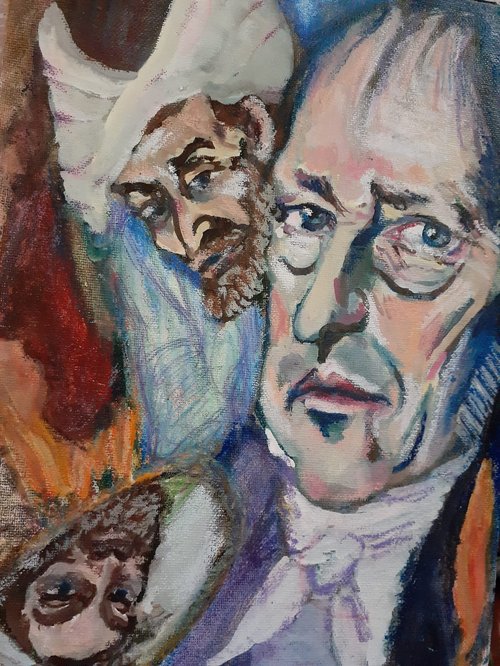
Attar & Hegel by Gail Campbell
Worlds in Rupture
Attar (Faridoddin Abu Hamed Mohammad Attar Nishapuri, c.1145-1221 CE), lived in Persia just before the Mongol invasions. He wrote in a time of spiritual richness and political fracture. His Conference of the Birds (1177) follows a flock of souls seeking the Simorgh, a symbol of the Divine. After crossing seven valleys – the valleys of Searching, Love, Knowledge, Detachment, Unity, Bewilderment, and Annihilation – only thirty birds remain. Then, in the reflection of one another, they discover the Simorgh – not as an external representation of God, but as God seen in the transfigured totality of the self in relation with others.
G.W.F. Hegel (1770-1831 CE), was a German philosopher writing in Europe at the end of the Age of Enlightenment. He witnessed the rise and unraveling of empires, including being present when Napoleon entered the town of Jena where he was a lecturer. The French Revolution had shaken the soul of European civilisation, and it demanded comprehension. Thus Hegel’s The Phenomenology of Spirit (1807) charts the unfolding of Geist – the Spirit of cultures – as it journeys through history, encountering alienation, contradiction, and reconciliation. (Geist becomes fully itself not by retreating from the world, but by moving through history and contradiction until it recognizes itself as the whole in freedom.)
Both thinkers responded to civilisational collapse. Both saw the self not as a static essence, but as a mind in movement. And both located truth on the far side of loss.
Alienation: Exile or Engine?
For Attar, alienation means metaphysical exile. The soul has strayed from its divine origin. But the valleys of testing and pilgrimage purify the heart until the ego melts into the real. As a drop dissolves into the sea, the self becomes what it always was – a reflection of the One. This final stage of this journey, fana, is not erasure, but unveiling: a disclosure of the truth.
For Hegel, alienation is a historical necessity, since throughout history the human self must confront and overcome its own divisions – between subject and object, self and other – in order to grow, and it does this through the Spirit’s movement through history. It is only through the ongoing generation of a set of ideas in a culture, then the generation of opposing ideas, and then the reconciliation of the opposing elements, that Spirit becomes conscious of itself in culture and humans become fully free. Here, alienation is not a fault to be remedied, but a path to be walked until total self-reconciliation is achieved.
Although their vocabularies differ – eg, ‘divine annihilation’ versus ‘dialectical sublation’ – both see estrangement from the world and from others as a threshold to sacred self-realisation.
Becoming Whole In the Mirror of the Other
Attar’s core revelation is that God is not beyond, but among. The thirty birds, when unified in their surrender, behold the Simorgh not as other, but as their own radiant reflection. Attar is saying that the divine is relational, and is mirrored in communion.
Similarly, Hegel’s Absolute Knowing – the Absolute Spirit fully knowing itself – emerges when Spirit recognizes itself in history by the synthesis of oppositional ideas and the social communion that results. It is not solitude that grants truth here, but reconciliation – the I that sees itself through and with the Thou. Wholeness is achieved not in isolation, but in shared becoming.
Both visions reject the myth of the self-contained self, then. What is ultimately Real is what is found, redemptively, in relation – albeit somewhat painfully sometimes.
East and West: Not Opposites, But Echoes
It has become common to set East and West in contrast: for instance, Attar the mystic versus Hegel the rationalist – one dissolving the self, the other crystallizing it. But this opposition is a mirage. Attar’s mysticism is not escapism, it is hard labour. The love, bewilderment, and annihilation he symbolises are acts of profound inner effort. Similarly, Hegel’s dialectic is not merely cold logic, it is Spirit, and so humanity, struggling to find itself in a shattered world. Each vision speaks to a humanity in crisis; and each offers transformation, not through avoidance, but through traversing problemed landscapes. So they do not cancel each other out. Rather, they complete each other.
A Final Reflection
Attar and Hegel never met. But perhaps they do now – in the eyes of you the reader, who can see both the sacred in the unfolding of mind (Hegel), and the divine in the dissolving of self (Attar), in the wider whole. Attar whispers: “Lose yourself, and you will find the One.” Hegel replies: “Know yourself, and you will become the Whole.” And perhaps both are right.
© Dr Rebwar Fatah 2026
Rebwar Fatah is a philosopher exploring the poetic and mythic dimensions of displacement, memory, and cross-cultural reconciliation. His work blends Sufi imagery, philosophical reflection, and lyrical narrative to reimagine human connection across borders and histories.
Advertisement
