


Your complimentary articles
You’ve read one of your two complimentary articles for this month. To have complete access to the thousands of philosophy articles on this site, please
You can register for a free account to have four complimentary articles per month. We will occasionally email you a newsletter, from which you can unsubscribe at any time. We do not sell personal data or otherwise disclose personal information to other organisations.
Metaphysics
Causation: A History
Peter Keeble causes us to think about causation.
There are many areas that might be used to trace the course of Western philosophy. Physical causation – an interesting topic in its own right – is a good example. And what a fascinating story that history is – one we should appreciate in all its roiling complexity, logic, and magnificence. At its heart are two ideas: that a certain event will, under the same circumstances, always and inevitably lead to the same effect; and that every event is the result of a cause. Traditionally this is illustrated with a billiard ball knocking into and causing another billiard ball to move. Of course, we might intervene and stop the second ball moving, or there may be an earthquake that upsets everything. But all things being equal – all relevant factors being unchanged – we think it is not just likely but inevitable that the first ball will cause the second one to move.
The story of human thinking about causation leads from ascribing it to acts of gods, through Aristotle’s view that causation expressed the essence of objects, then the eleventh century Islamic philosopher Al-Ghazali’s assertion that causation is God’s habit of intervening in the world. New ideas arose with the birth of modern science and the responses of rationalist and empiricist philosophers, until, through the puzzles of the quantum world and analytical philosophy’s retreat from metaphysics, the New Essentialists recently went back to the ideas of Aristotle.
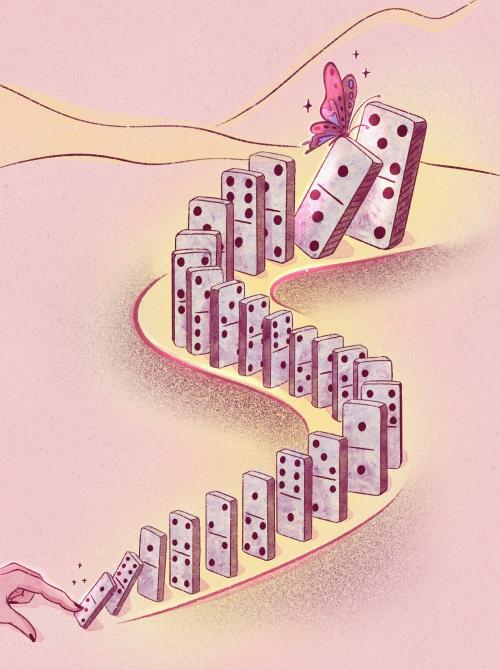
© Oksana Cherepashchuk. Instagram: @oksana.cherepashchuk
Rationalism
Gottfried Leibniz (1646-1716) and Baruch Spinoza (1632-1677) were both determined to demonstrate that every event had a cause. They were both great champions of the principle of sufficient reason – the idea that for everything there must be a cause or set of causes that adequately explains why that thing exists. This implies that nothing could come into existence from nothing (in other words, without a cause). If so, there has to be at least one self-sufficient substance – something that exists necessarily, or as we might say, is the cause of itself. However, they also believed that different substances could not cause an effect one to the other, partly because they were trapped in Aristotle’s logic based on propositions consisting of subjects and their projects with not separate account of relationships. This problem seemed most acute when it came to the interaction of mental and physical substances (that is, the mind and brain), as outlined by Descartes. How could the non-physical mind cause changes in the physical brain?
Spinoza answered that there is only one substance. The entirety of nature, including minds and physical extension, are but aspects of this one substance. And so for him the problem of mind/body interaction dissolved. Leibniz, by contrast invented a bizarre system of ‘pre-established harmony’ between different substances he called monads. The mental and physical realms are like separate pre-set clocks which have been wound up to run in harmony with the other at their creation by God. Therefore, although mental and physical do not interact it appears as though they do, because they continue to run in harmony.
Both these rationalist philosophers had, they thought, preserved the idea of a universe in which the same cause always leads to the same effect under the same circumstances. Science then could proceed on this basis, with absolute confidence that there was order in the universe.
Hume the Sceptical Empiricist
Then along came David Hume (1711-1776) with a simple observation: where is the certainty that when we observe cause A it will result in effect B? If we see a billiard ball hit another billiard ball, and that ball moves, that’s all we see. There’s no certainty visible, so something else entirely might have occurred: on contact the second ball might have rebounded, exploded, disappeared, or changed colour.
This doubt, argued Hume, could be carried forward into all instances of causation. This means that no matter how many times you see the second billiard ball move, it doesn’t mean you’ve confirmed that it’s a necessary effect of having been hit by the first ball. So Hume said our notion of causation comes from constantly seeing one event following another event, and is but a phantom of expectation built up by repeatedly experiencing the same ‘cause’ result in the same ‘effect’. Science and induction therefore rest on essentially nothing but the hope that the universe will continue to behave in the way it always has.
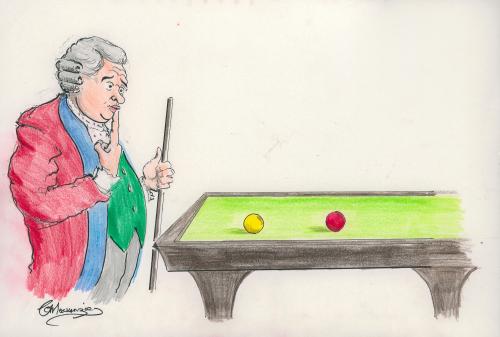
Hume Contemplates Causation by Colin Mackenzie
This is a troubling observation. However, there are two caveats. First, Hume is relying on the same inductive reasoning he is questioning in order to claim that all we will ever see is the constant conjunction of events, never any necessary causal link. How does he know that the next time we see the billiard ball experiment we will not suddenly say, “Ah, I see it now: the second ball must move when hit by the first one”? Alternatively, if Hume is not relying on induction, then the apparent absence of necessity must be a matter of logical deduction. So Hume seems to be cornered into saying that it is a matter of logic that we can never see the necessity of causation. But this seems to be a rationalist (knowledge through reason) position rather than a result of the empiricist (knowledge through experience) position he otherwise claims for himself.
Leading on from this, could it be that Hume is sure he will never see the necessity of causation simply because he has made the logical error of thinking that the necessity is something extra that could be seen independently of our observing apparent causality in action? This idea is often ascribed to Elizabeth Anscombe, who says in Causality and Determination (1971) that Hume distracted us from seeing the causal inevitability built into active verbs. More straightforwardly, we may say, of course Hume cannot see necessity in causation, because necessity is not the sort of thing you can see even if you know it’s there. You cannot see it any more than you can see ‘alacrity’ as a separate element in my greedily snatching the last chocolate from the box. Alacrity and necessary causation are not separate qualities that can be seen. They are inseparably entangled in actions, not separate from them.
Be that as it may, Hume cast serious doubt on the common-place belief that there’s an inevitability about causes and effect. So much so that Kant launched into a massive effort to explain why causal inevitability must be so.
Kant
Immanuel Kant (1724-1804) thought Hume had a point. So, desperate to preserve the idea of necessary causation (and hence justify a faith in science, which relies on causal regularity), he formulated a worldview that influenced Western philosophy for centuries, until somewhat punctured by the likes of Nietzsche and Einstein. During the nineteenth century Kantian thinking resulted in the weirdness of idealists such as GWF Hegel, or in Britain, John McTaggart and Thomas Green – and then in the counter swing of the pendulum against metaphysics towards logical positivism and analytic philosophy.
It’s ironic that Kant essentially agreed with Hume’s observation that no one can see causal necessity as a feature of the world, but nonetheless we take it as read, since Kant’s neat, yet radical, solution, was to say that causation (as well as space and time and other basic aspects of our experience) is not a feature of the world itself, but of the human mind.
Kant agreed with the rationalists that the newborn’s mind is not, as the empiricists claimed, a blank slate. Instead Kant said that from birth our minds are imprinted with certain basic predispositions to experience and think in certain ways. Kant called these ‘categories’. Crucial among these categories are ideas of space and time, and causation too: no experience was possible without these essentials. To Kant the categories are the bedrock of our ability to make sense of the otherwise incomprehensible noumenal world – the world as it exists independent of our senses – by translating it into the phenomenal world of our sensory experience. They are therefore necessary aspects of the world as far as we’re concerned. Just as the person wearing pink contact lenses from birth will not be able to conceive of a world that’s not infused with pink, so we are unable to conceive of a world where billiard balls will not behave in the causal way we instinctively know they must.
The claims are linked. Physical causation depends on the ideas of space and time: some place for an event to happen, and a time during which the sequence ‘cause followed by effect’ takes place. However, in our post-Darwinian age we might argue that while these ways of experiencing may be automatically or instinctively built into our minds (let’s grant Kant that, though it’s arguable), that may simply be because space, time and causation are actual features of the real world. Any creatures who did not experience those features from birth (or at least early on) would not survive. We do survive, it may be argued, because we experience the real nature of the universe. What need, then, for Kant’s unobservable noumenal world?
Moreover, as I hinted, twentieth century science and technology have cast further doubt on Kant’s metaphysics. They indicate that space and time are real aspects of the world, which we can observe behaving in quite unexpected ways that our instincts or intuitions would never have predicted. For example, based on observations such as gravitational lensing, Richard Feynman used the analogy of space being like jelly. In any case, scientific observations seem to directly contradict Kant’s view that space and time are mere products of our minds.
Kant did advance arguments specific to causal necessity. Firstly he drew a distinction between subjective and objective perception. Subjective perception occurs when our eyes wander around the view in no particular order. For example, we may look at a house – at the front door, the windows or the roof – in any order we please. But in an objective perception we are constrained. His example is of seeing a boat float downstream. To be meaningful this can only be seen in a particular order; from upstream to downstream; and we know this because of the rules of causation. Without this idea of causal succession, life would be a dreamlike parade of unconnected events, or like individual stills from a film strip shown in a random order. Kant goes further than Hume in one sense, then, by saying that it’s not just that we cannot see necessity in causation: we could not acquire the idea of causation at all just from looking at what would otherwise seem to be unconnected images, say of a ship floating downstream. Kant argues therefore that throughout our everyday experience we’re applying in-built rules of causation, such as ‘every event has a cause’. Such rules are described by Kant as synthetic a priori statements, which just means that we know in advance of experience that they’re true, yet they seem to tell us something in addition to the sheer meanings of the individual words. We know every event has a cause, it is being argued, for the same sort of reason a person wearing pink-tinted contacts knows that everything they see will be pink: they are providing the cause, or the tint. The arguments from both objective experience and acquisition of synthetic a priori knowledge both lose their edge if you observe an infant experimenting with the world of cause and effect to gradually become more familiar with it.
Kant has another technique for trying to demonstrate that causation is a feature of our mental make-up rather than of the world independent of experience. This involves what he calls ‘the antinomies of pure reason’. These are logical contradictions he says occur when we try to apply some ideas, such as space and causation, beyond the world of our experience, to the universe itself. In the causation case he says that if the world is not eternal then there must have been a first cause. But, he points out, reason also says that every cause must have a previous cause, which leads to an eternal regress and an eternal universe. The universe cannot be eternal because then there would have had to have been an eternity before we arrived at our time; yet by definition an eternal time cannot be traversed; so how could we ever get to our time at all, in order to exist and make these arguments? This contradiction arises, claims Kant, because we are mistakenly applying the rules of causality to a realm where they do not belong – the world outside the mind.
Kant’s antinomies do raise issues about our picture of the world, including of space, time and causation. However, the idea that causation (and necessary causation at that) is how our minds perceive the world rather than being an independent feature of that world is in my opinion incorrect. Kant’s arguments here are not compelling. They are inconsistent with a real world of causation that we’re adapted to; and they’re at odds with scientific observations of distortions in the space-time continuum. The antinomies are puzzling paradoxes; but paradoxes in our conceptual scheme do not prove Kant’s position. They just demonstrate that something in our worldview needs sorting out.
The Retreat from Kantian Metaphysics
Partly as a result of demonstrations of the shortcomings of Kant’s (and Hegel’s) metaphysics, twentieth century philosophy took the cold shower of the verification principle, Popper’s falsifiability test, and Wittgenstein’s admonishment of those seeking to speak of what cannot be spoken of, to dig the bolthole of logical positivism, whose proponents (such as AJ Ayer) claimed that philosophical problems were just confusions of language that would disappear once the language was clarified. With the subsequent elaboration of Anglo-American analytic philosophy, the study of causation became less about causation’s basic nature, and more an exercise in finding which form of words best captured all examples of causation and excluded all cases that were not. As in Feynman’s exhortation to scientists to ‘shut up and calculate’, English-language philosophers were called to ‘shut up and define’.
As a result, analytic philosophy offered up several alternative accounts of causation. Two of them were counterfactualism and contextualism. The former said that a cause was that even t but for which the effect would not have happened. So the match would not have lit but for it being struck. Contextualism, on the other hand, defined causation in terms of salience – as about considering the most relevant factors in the account. In a court of law, the arsonist’s motivation might be considered more significant as the cause of the fire than the striking of the match.
The problem with both of these accounts of causation is they allow for multiple causes of equal strength for the same effect. In the case of counterfactualism, the presence of oxygen in the air is also a but for which the fire would not have happened; and if you take the contextualist outside the law court, then there is a whole array of other potential causes for the arsonist’s action, such as their troubled upbringing. Perhaps this apparent ‘overdetermination’ would not matter if we see all events as being effects of the whole preceding history of the universe, for which it would be artificial to single out one element as the solitary cause. That would be claiming something more about the reality of causation and the universe in which it exists than these ingenious language-based accounts. But much modern analytic philosophy seems to be allergic to metaphysics.
The New Essentialism
One recent new approach to causation is that of New Essentialism, interestingly explored by the Australian philosopher Brian Ellis (1929-2025). This revives Aristotle’s concept of the natural kind, which states that there are mind-independently different types of entities in the world, and that because of their natures or essences, they must behave in certain ways. Ellis suggested that elements, atoms and subatomic particles are natural kinds. They necessarily have their specific properties or powers in all possible worlds. If you changed them in any crucial way so they no longer had these effects, then they would no longer belong to that class of natural kind. So, it is part of the essence of an electron to have a negative charge; it doesn’t ‘just happen’ to repel other electrons – it must do so because doing that is what an electron is.
Instead of being passive entities that just happen to follow laws imposed on them, these natural kinds possess inherent causal powers. So according to Ellis, causal necessity isn't an idea in our minds as Hume claimed; but is grounded in the properties of the things themselves. It’s part of what makes them what they are. Just because we might be able to imagine water molecules behaving in a non-water-like manner, that does not mean that they could. Ellis characterises this as metaphysical necessity (in distinction from logical or linguistic necessity). Laws of nature emerge, as it were, from the qualities or properties of these entities. This means they are immanent (built-in) to the kind of things that exist, not separate rules somehow imposed from outside. So causal powers are real and irreducible, and they define the natural kinds. To have different causal laws, we would have to have different substances.
Causation exists because what exists must behave the way it does in the circumstances. I suspect this is how most people would claim causation worked if you quizzed them about it. And this account escapes the problems with the idea that objects passively obey laws of nature. The major problem with that idea is that the laws of nature (for example Newton’s first law of motion: objects keep moving in the same way unless a force intervenes) are merely describing what happens, not explaining why it happens. Instead, Ellis and the New Essentialists take a downward path, explaining what happens at a lower level of analysis.
An adherent of Hume can still ask, Why does the element, atom, or particle behaves as it does? Ellis says it’s a matter of metaphysical necessity. Is that enough to put a stop to the search of empiricists to explain something the Essentialist think is in some way necessary?
Quantum Physics: the (Very Small) Elephant in the Room
There’s a quantum elephant in the room of necessary causation. In a variety of quantum scenarios – whether it be atomic decay, the double slit experiment or quantum entanglement – we seem to have uncaused events that break the principle of sufficient reason: in other words, they seem to happen where and when they do without a cause. Nonetheless, although apparently random in the behaviour of the individual wave-particles, quantum phenomena do follow statistical patterns, and that suggests some sort of causal influence. Still, the causal principle does not seem to apply as it should in this realm. Moreover, observations confirm Bell’s equation, which is said to prove there are no hidden quantum causes that we just cannot detect. As a result, there have been desperate attempts to maintain the principle of sufficient reason in terms of universal causation even in the quantum realm, through, for example, backwards causation – the idea that future events can cause effects in the past.
Such ideas blur the demarcation line between science and philosophy concerning causation. This was shifted away from Kant in favour of science with the verification of Einstein’s theories that space-time can be distorted. But looking at the world of quantum physics, a neo-Kantian might be allowed a slight smile. Is quantum indeterminism a sign of the incomprehensible noumenal world peeping through? Or is it, in line with Hume, a demonstration that there is no ultimate causal necessity in the world? Or is it instead something that will, on some greater level of evidence or understanding we haven’t attained yet, fit in with the principle of sufficient reason?
Conclusion
I think almost everyone instinctively believes that events must be caused. But is this just the ‘constant conjunction’ of supposed causes with effects lulling us into a false certainty? Or is it a reflection of how the world actually is? If the latter, how do we account for seemingly causeless quantum indeterminacy?
For me the issues of causation illustrate the beauty of philosophy – the tantalising tussle between two reasonable views which seem to contradict each other. I feel certain that effects follow necessarily from causes, but have yet to see an irrefutable way of demonstrating this.
© Peter Keeble 2026
Peter Keeble is a poet, and a retired teacher and local government research officer, who lives in Harrow, London.
Advertisement
